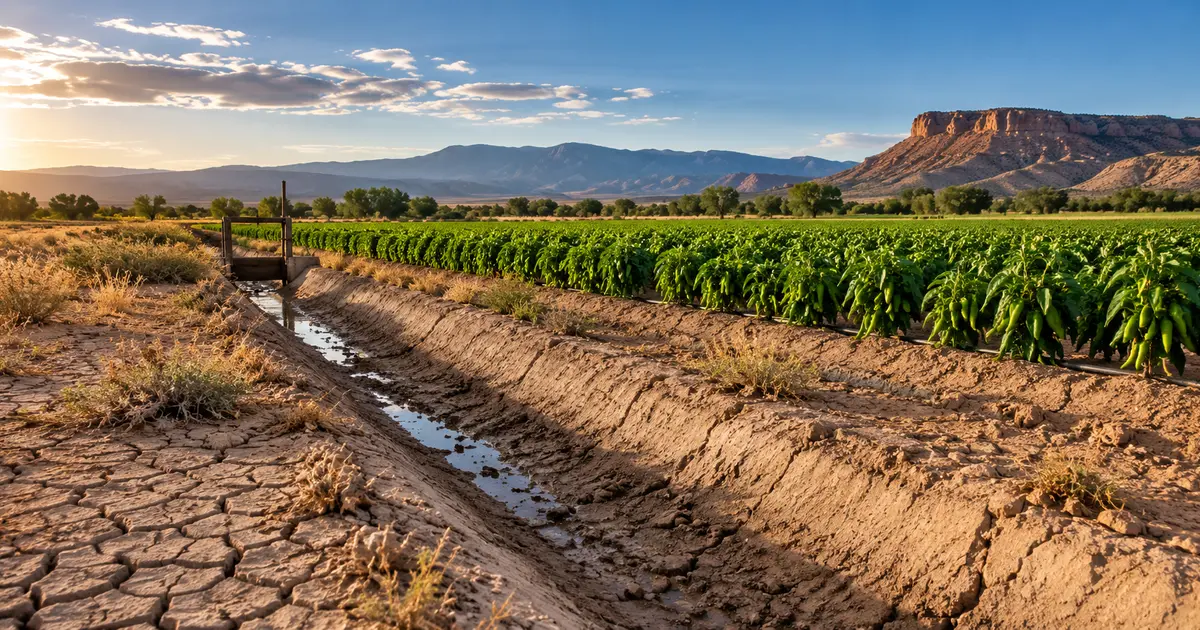
New Mexico Water Problems: Solutions for the Future of Farming
Water has always shaped life and agriculture in New Mexico. Today, limited water supplies, drought, groundwater pressures, aging irrigation infrastructure, and competition for available water are making water management one of the most important issues facing the state’s agricultural future.
For New Mexico farmers and ranchers, water scarcity isn’t simply an environmental issue. It is an agricultural, economic, and rural-community issue.
Addressing New Mexico’s water problems will require more than finding additional supplies. The state will need to use existing water more efficiently, modernize agricultural infrastructure, invest in conservation, and develop farming systems designed for an increasingly water-limited environment.
Why Does New Mexico Have a Water Problem?
New Mexico is naturally one of the driest states in the United States. Drought and highly variable precipitation have always been part of the state’s climate.
The challenge becomes greater when prolonged dry conditions combine with agricultural demand, groundwater pumping, population growth, evaporation, changing snowpack, and unpredictable river flows.
Agriculture is particularly important to this discussion because irrigated agriculture represents a major share of New Mexico’s water use.
That also means agriculture represents one of the biggest opportunities for investments in water efficiency.
Drought and New Mexico Agriculture
New Mexico farmers have always dealt with dry years, but prolonged drought and unpredictable water supplies can make agricultural planning increasingly difficult.
Farmers need reliable information about available water to determine what crops to plant, how many acres to cultivate, and whether investments in equipment and infrastructure make economic sense.
When water availability becomes unpredictable, farming becomes more financially uncertain.
That uncertainty can affect not only farmers but also agricultural workers, suppliers, processors, rural businesses, and communities that depend on agriculture.
The Rio Grande and New Mexico Farming
The Rio Grande is much more than an iconic New Mexico river.
It provides water for cities, communities, ecosystems, and agriculture throughout the state.
In southern New Mexico, water stored in reservoirs and released into irrigation systems is particularly important for agricultural production.
When reservoir supplies and river flows decline, farmers may have fewer surface-water resources available.
In some areas, this can increase reliance on groundwater.
That creates another long-term challenge.
Groundwater Cannot Be an Unlimited Backup Supply
Groundwater is essential to many New Mexico farms and communities, especially when surface-water supplies are inadequate.
But aquifers are not unlimited.
When groundwater is withdrawn faster than it can be replenished, water levels can decline. Farmers may eventually need to pump water from greater depths, potentially increasing energy and operating costs.
Long-term groundwater management therefore needs to balance agricultural production with the sustainability of the resource.
One possible approach is voluntary conservation programs that compensate agricultural producers for measurable reductions in water consumption.
This creates an important principle for New Mexico’s future:
Water conservation can become an agricultural investment rather than simply a restriction on farmers.
Agriculture and New Mexico’s Water Supply
Agriculture is one of New Mexico’s largest water users.
But agricultural water should not be viewed only as consumption.
It supports farms, ranches, food production, rural employment, local businesses, traditional communities, and generations of New Mexico agricultural heritage.
The goal should therefore not simply be to remove water from agriculture.
A better question is:
How can New Mexico create greater agricultural and economic value from every acre-foot of water?
That question could become the foundation of a new agricultural strategy for the state.
Aging Irrigation Infrastructure
Some agricultural water infrastructure in New Mexico was developed long before today’s irrigation technologies became available.
Canals, acequias, pumps, gates, pipelines, storage systems, and water-delivery infrastructure can potentially be modernized to give farmers greater control over when and how water reaches crops.
Investments in agricultural water infrastructure could help reduce unnecessary losses while improving the reliability of irrigation.
Modernization does not mean abandoning New Mexico’s traditional agricultural systems.
It means combining those systems with technology where technology provides measurable benefits.
Precision Irrigation and Smart Farming
Modern irrigation technology could help New Mexico farmers produce crops with greater control over water use.
Depending on the crop, farm, soil, and location, technologies could include:
- Drip irrigation
- Soil-moisture sensors
- Automated irrigation controls
- Weather-based irrigation scheduling
- Flow meters
- Remote crop monitoring
- Variable-rate irrigation
- Improved pumps and pipelines
- Precision agriculture software
Technology alone will not solve New Mexico’s water problems.
However, combining technology with the knowledge and experience of New Mexico farmers could substantially improve the way limited water supplies are managed.
Greenhouse Farming and Controlled-Environment Agriculture
Another opportunity is to examine whether some agricultural production can move toward systems that capture and reuse water.
Greenhouses, hydroponics, recirculating irrigation, and controlled-environment agriculture can provide much greater control over water, nutrients, temperature, humidity, and growing conditions.
These systems will not replace conventional New Mexico agriculture.
Nor should they.
Traditional farms, ranches, orchards, acequias, dairies, and field crops will continue to play an important role in the state.
However, greenhouse agriculture could become another component of New Mexico’s agricultural economy, particularly for high-value crops where improved water efficiency can help justify higher infrastructure costs.
Agricultural Water Recycling
One of the most promising long-term opportunities may be agricultural water recycling.
Instead of using water once and allowing much of it to leave the production system, recirculating agricultural systems can capture, treat, and reuse water.
This approach could be particularly valuable in greenhouse and controlled-environment agriculture.
New Mexico could encourage research and demonstration projects designed to determine which water-recycling systems are technically practical and economically viable under the state’s conditions.
Could New Mexico Become a Leader in Water-Efficient Agriculture?
New Mexico’s water challenges could also create an economic opportunity.
Dry regions throughout the American West and around the world face similar questions:
How can we grow more food with less water?
How can agricultural water be recycled?
How can irrigation be monitored more precisely?
Which crops create the greatest economic value from limited water?
How can farmers remain profitable when water becomes less predictable?
Instead of viewing New Mexico only as a state facing water scarcity, the state could become a testing ground for the future of arid agriculture.
Farmers, universities, engineers, agricultural technology companies, entrepreneurs, government agencies, and investors could work together to develop and demonstrate technologies with applications throughout the Southwest and other dry regions.
Paying Farmers to Conserve Water
Farmers cannot reasonably be expected to carry the entire financial burden of solving a statewide water problem.
If communities and the broader economy benefit from agricultural water conservation, programs should consider helping farmers finance the transition.
Possible approaches include:
- Cost-sharing for efficient irrigation equipment
- Agricultural water conservation grants
- Low-interest infrastructure loans
- Voluntary conservation payments
- Funding for water-recycling systems
- Greenhouse and controlled-environment agriculture grants
- Precision agriculture incentives
- Agricultural technology demonstration programs
- Acequia and watershed restoration funding
Conservation programs developed with farmers rather than simply imposed on farmers have a better chance of producing durable results.
Protecting Acequias and Traditional New Mexico Agriculture
New Mexico’s agricultural future should not require abandoning its agricultural past.
Acequias are an important part of the state’s history, communities, culture, and agricultural identity.
Agricultural modernization should therefore include investment in traditional farming communities as well as advanced technology.
Restoring watersheds, improving acequia infrastructure, reducing unnecessary water losses, improving measurement, and helping small farms adopt appropriate technologies could help preserve traditional agriculture while preparing it for future water conditions.
Research and Demonstration Farms
New agricultural technologies need to be tested under real New Mexico conditions.
Research farms and demonstration projects could test irrigation technologies, greenhouse systems, alternative crops, water recycling, sensors, renewable energy, and other agricultural technologies.
These projects should answer practical questions:
How much water does the technology actually save?
How much does it cost?
Does it increase crop value or yield?
Can farmers operate it economically?
How long does the equipment last?
Can the technology work on commercial farms?
Answering these questions can help separate promising agricultural technology from ideas that are not economically practical.
Renewable Energy and Agricultural Water
Water and energy are closely connected.
Pumping, transporting, treating, cooling, and recycling water all require energy.
New Mexico’s solar resources could provide opportunities to integrate renewable energy with agricultural water systems.
Solar power could potentially support irrigation pumps, greenhouse equipment, sensors, water-treatment systems, cooling equipment, and other agricultural infrastructure.
Combining renewable energy with water-efficient agriculture could help create more resilient farming systems.
New Mexico Needs a Long-Term Agricultural Water Strategy
A comprehensive agricultural water strategy could focus on several priorities.
Modernize irrigation infrastructure. Help farmers replace aging or inefficient water-delivery systems.
Expand precision agriculture. Make sensors, meters, and intelligent irrigation systems accessible to farms of different sizes.
Invest in agricultural water recycling. Develop farming systems capable of capturing and reusing water.
Support groundwater sustainability. Develop voluntary programs that reduce pressure on stressed aquifers while protecting agricultural communities.
Expand agricultural research. Test crops and production systems designed specifically for New Mexico’s climate.
Develop controlled-environment agriculture. Expand greenhouse and recirculating systems where they make economic sense.
Protect traditional agriculture. Invest in acequias, watersheds, family farms, and rural communities.
Reward measurable conservation. Create economic incentives for farmers who produce meaningful water savings.
Building a Stronger Future for New Mexico Agriculture
Solving New Mexico’s water challenges is only one part of creating a stronger and more resilient agricultural economy.
Water infrastructure needs to be connected with agricultural research, new farming technologies, greenhouse development, farmer assistance, workforce development, new markets, and long-term investment.
Our broader Growing New Mexico’s Agricultural Future plan explores how these ideas could fit together through a long-term strategy for agricultural infrastructure, innovation, funding, and economic development.
Water conservation should not exist as an isolated policy.
It should be part of a larger effort to make New Mexico agriculture more productive, competitive, and resilient.
New Mexico’s Water Problem Could Become an Opportunity
There is no single solution to New Mexico’s water challenges.
But doing nothing could eventually become more expensive than investing in solutions today.
New Mexico already has many of the ingredients needed to become a leader in water-efficient agriculture: experienced farmers, agricultural communities, universities and researchers, abundant solar resources, and a strong incentive to develop better ways of producing food with limited water.
Those assets could help the state develop expertise in water-efficient agriculture, greenhouse farming, precision irrigation, agricultural water recycling, and farming technology for arid regions.
Technologies proven in New Mexico could eventually have applications throughout the American Southwest and other water-limited agricultural regions.
Growing More With Less Water
The future of New Mexico farming may ultimately depend on a simple principle:
Every drop of water needs to create more value.
That means protecting existing farms while investing in infrastructure and technologies that make agriculture more efficient and resilient.
It means giving farmers the tools and financial incentives needed to conserve water without sacrificing their economic future.
And it means treating New Mexico’s water challenge as an opportunity for agricultural innovation rather than simply a problem to manage.
If farmers, researchers, universities, businesses, government agencies, and communities work together, New Mexico could become a national leader in farming for an increasingly water-limited world.
New Mexico’s agricultural future begins with water.